




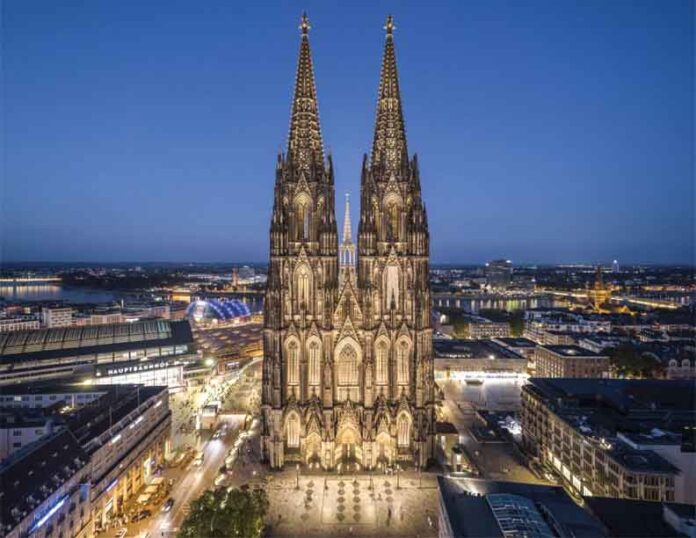
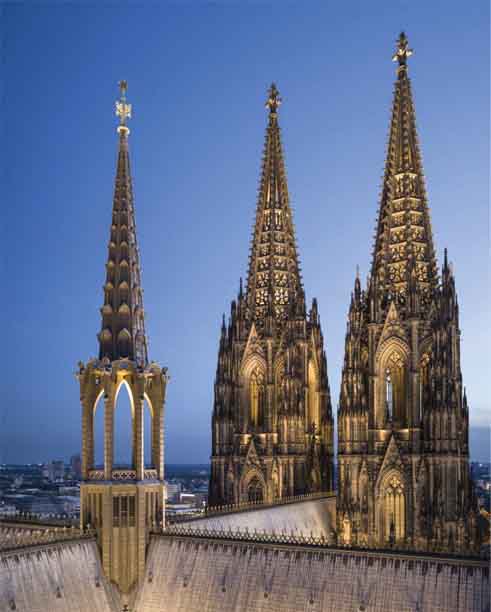
With the transition to a modern and precise LED system, the cathedral—designated a UNESCO World Heritage Site since 1996—now presents a striking visual presence after dark and during twilight. Designed with strong ecological considerations, the project significantly reduces both light pollution and energy consumption.
The origins of illuminating the cathedral date back to 1838, when Crown Prince Friedrich Wilhelm IV announced a visit to Cologne. In his honor, the still-incomplete Gothic structure—then nearly six centuries into construction—was illuminated for the first time. The gesture proved impactful; four years later, as king, he laid the foundation stone to resume construction. Although, the cathedral was eventually completed, it was not until 1929, under Mayor Konrad Adenauer, that a permanent lighting system was introduced, transforming its iconic twin towers into a defining feature of Cologne’s nighttime skyline.
The cultural and symbolic importance of this illumination became especially evident in the summer of 2022, when lighting for public buildings—including the cathedral—was turned off due to the energy crisis triggered by Russia-Ukraine War. By that time, however, Licht Kunst Licht had already begun developing a sustainable lighting solution appropriate to the cathedral’s significance. An early indication of this effort came in 2020 with the installation of the Star of Bethlehem atop the crossing tower.
Previously, the cathedral was illuminated primarily by floodlights mounted on surrounding rooftops. The outdated 1000-watt metal halide lamps consumed large amounts of energy and cast a uniform neutral white light over the entire structure. While effective in making the cathedral visible, this approach diminished architectural detail and contributed significantly to light pollution in the surrounding area.

Licht Kunst Licht approaches illumination as an integral element of architecture—a philosophy that posed unique challenges in this project. As Philipp Schmitz, lighting designer and project lead, explains, the lack of detailed architectural documentation required extensive on-site analysis. Digital simulations proved insufficient for such a complex and varied structure, leading the team to conduct years of empirical testing with optics, angles, and positioning to achieve the desired lighting effects.
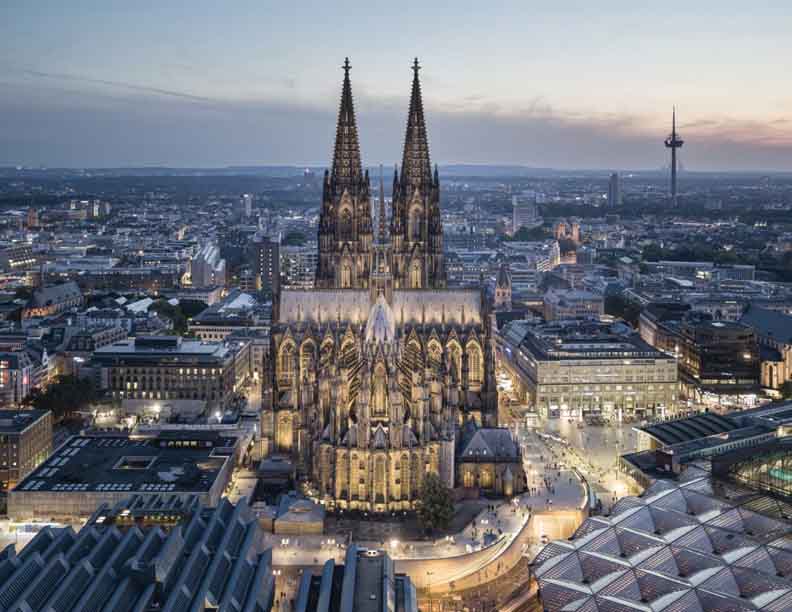
Working closely with the Dombauhütte and RheinEnergie, the team developed a system of over 700 precisely positioned fixtures. These compact, glare-free luminaires were installed discreetly on or near the historic structure, remaining virtually invisible during daylight hours. Designed to blend seamlessly with the architecture, they avoid drawing attention as standalone objects.
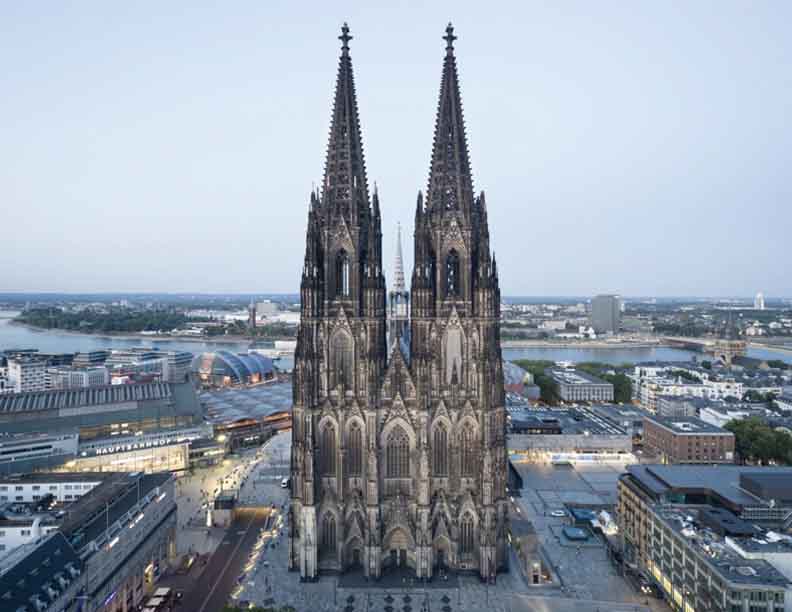
A significant shift in lighting strategy is evident in the placement of fixtures. Whereas previously 80% of the light originated from distant sources, the new system reduces this to just 10%, dramatically improving precision and minimizing light spill. The lighting is fully dimmable, with adjustable color temperatures reaching a warm white of up to 2,700 K—harmonizing with the cathedral’s sandstone and allowing for seasonal and environmental adaptability.
Sustainability was central to the project’s design. The new system achieves an 80% reduction in energy consumption, operating at just 11,000 watts while
delivering superior visual quality. All installations are non-invasive and reversible, respecting the cathedral’s architectural integrity and its status as a living heritage site. Instead of drilling, custom clamping systems with lead-padded brackets were developed to securely mount the fixtures while protecting the historic fabric.
The lighting system is controlled from two central points—one at ground level and another within the crossing tower—as well as through remote access. This allows for flexible operation, enabling both individual and coordinated lighting scenarios.
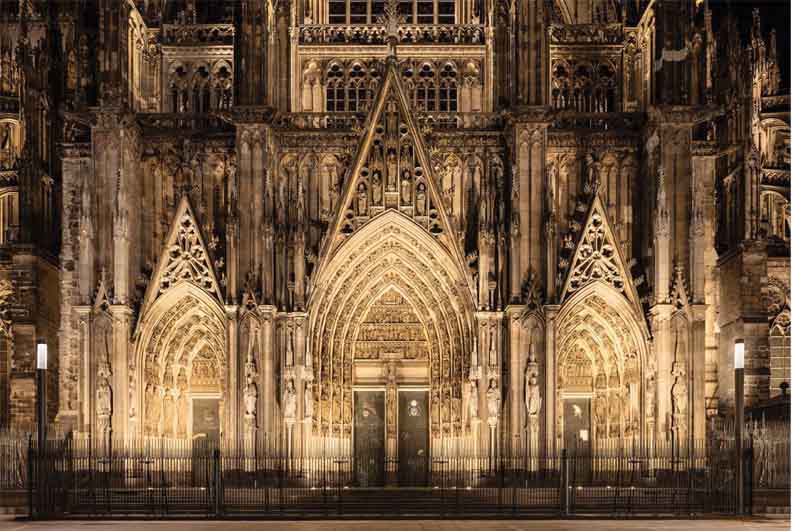
Through the use of directional and grazing light, the design enhances the cathedral’s spatial depth and verticality. Architectural elements such as buttresses, pinnacles, and sculptural details are accentuated through a dynamic interplay of light and shadow. Special emphasis has been placed on the cathedral’s 157-meter towers, where a combination of gentle backlighting and vertical grazing light highlights their striking form up to the spires. A notable innovation is the internal illumination of the towers, which shines through the delicate Gothic tracery, reinforcing the cathedral’s presence as a luminous landmark in Cologne’s nighttime skyline.
For the cathedral plaza, all stakeholders collaborated on the development of multifunctional lighting poles. These minimalist stainless-steel structures integrate seamlessly into the urban environment. Equipped with glare-free modules, they provide illumination for orientation near entrances and portals, while additional spotlights subtly highlight selected facade elements. All light sources are carefully shielded to prevent glare and preserve key sightlines.
As Philipp Schmitz reflects, the cathedral is deeply embedded in Cologne’s identity, and the goal was to preserve its presence after nightfall while revealing its architectural richness. The result is a sculptural and dignified nighttime appearance that remains visible even from across the Rhine—leading many to suggest that the cathedral now appears even more striking at night than during the day.
Client: RheinEnergie AG on behalf of the City of Cologne
Construction Management: Kölner Dombauhütte, Metropolitankapitel der Hohen Domkirche zu Köln
Electrical planning: Elektro Baeth GmbH, Cologne
Photos: HGEsch
Text: Uta Winterhager