





DP Architects has announced that the Singapore Pavilion at Expo 2025 Osaka has received the Grand Award at the iSMART Design Award during Guangzhou Design Week 2025 (GZDW), held in December 2025. The award programme, organised by Guangzhou Design Week, recognises outstanding spatial designs that demonstrate excellence in functional innovation, technological integration, and aesthetic advancement.
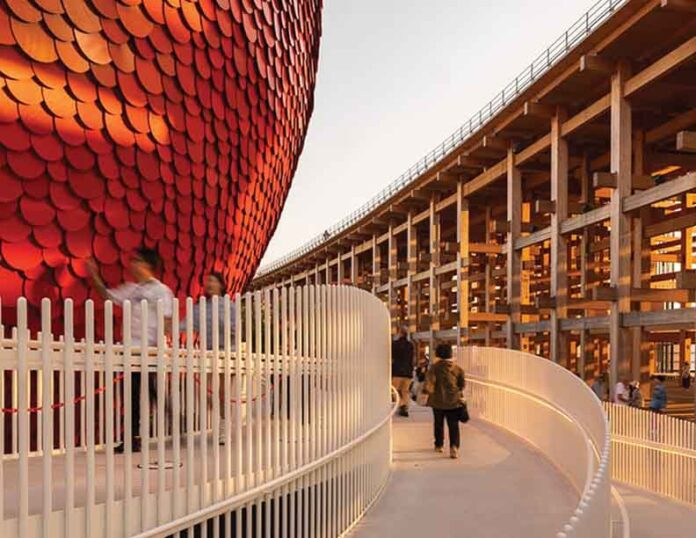
Commissioned by the Singapore Tourism Board, the pavilion was conceived as both a physical and symbolic expression of Singapore’s national ethos—small in size, big in dreams. Known as The Dream Sphere, the 17-metre-tall spherical structure draws inspiration from Singapore’s well-known nickname, the “Little Red Dot.”
Designed in collaboration with Kingsmen Exhibits, KR+D, Presplay, Milla & Partner GmbH and Finding Pictures, the pavilion embodies Singapore’s values of inclusion, collaboration, and innovation. These principles not only shape the nation’s development but also align with the central theme of Expo 2025 Osaka—“Designing Future Society for Our Lives.”
The pavilion’s façade is composed of 17,000 recycled aluminium Dream Discs, which incorporate the traditional Seigaha wave motif, symbolising the shared island heritage of Singapore and Japan and their mutual values of resilience. Varying in size and texture, the discs create a shimmering, tactile surface that reflects the collective aspirations of Singaporeans. Carefully engineered and assembled, each disc is mounted using a customised fixing system designed to accommodate the curvature of the Dream Sphere. steel and modular components, the pavilion allows for efficient assembly and disassembly, enhancing construction efficiency, reducing installation time, and ensuring accuracy despite the sphere’s complex geometry. The resulting façade forms a unified yet expressive architectural skin—an intricate tapestry of individual elements symbolising collective dreams and aspirations, while expressing a broader vision of unity and possibility.

Accessibility has been integral to the pavilion’s design. Visitors of all abilities can comfortably navigate the space through ramps and lifts, while braille maps and tactile signage support visually impaired guests. Sustainability also plays a fundamental role in both concept and construction. Guided by the 4Rs—Reduce, Reuse, Recycle and Renew—the façade incorporates 70% post-consumer recycled aluminium, reducing embodied carbon by approximately 70 tonnes of CO2, equivalent to the annual carbon absorption of around 2,500 trees.
More than an architectural landmark, the Singapore Pavilion at Expo 2025 Osaka serves as a platform for shared dreams and values. By bringing together innovation, sustainability, and inclusive design, it invites global audiences to imagine, collaborate, and contribute towards a more resilient, inclusive, and better-than-sustainable future.