










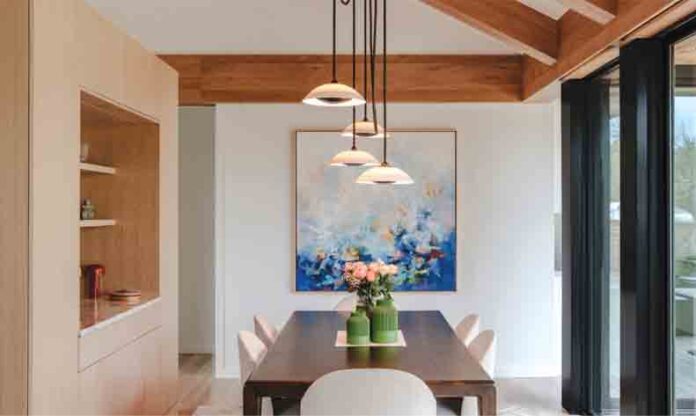
That idea now takes a more technological turn through the studio’s collaboration with Lutron Electronics. Announced in August 2026 as part of Lutron’s Native by Design programme, the partnership brings Lutron Intelligent Lighting directly into Ted Bradley Studio’s handcrafted Ring and Dome collections. The result is a meeting of porcelain, geometry and programmable light, where the technology is built into the object rather than added to it later.
The Object
Ted Bradley’s approach begins with material rather than technology. The studio is known for creating decorative lighting from hand-formed porcelain, treating each fixture more like a sculptural object than a conventional luminaire. Its porcelain rings, for example, take more than 200 individual steps and around three weeks to produce. The studio developed its own process for creating the geometrically precise forms, working through hundreds of failed attempts before arriving at the finished technique.
That level of craftsmanship is important to the character of the project. The light source is not the only thing being designed; the surface through which that light is experienced is equally significant.

The studio’s porcelain is available in a range of finishes, from untreated White Stone Matte to glazed surfaces that are fired at temperatures above 2,000°F. Metal components are also individually polished and given their final patina by hand.
The result is deliberately tactile. Even when the fixture is not illuminated, its form, texture and finish remain central to the space.
Light Within
The Lutron collaboration changes what happens once the fixture is illuminated. Rather than keeping the decorative sculpture and lighting-control system as separate components, Lutron’s Intelligent Lighting technology is integrated directly into the Ring and Dome collections. The fixtures can therefore become part of a wider Lutron lighting system while retaining the visual language created by Ted Bradley Studio.
This is particularly interesting in the case of the Ring collection. Bradley’s porcelain rings are already designed around the idea of light emerging from a sculptural form. The studio describes each ring as a handmade work of art, with more than a thousand dimmable LEDs incorporated into the sculpture.
With intelligent lighting integrated into the fixture, that illumination is no longer simply an on-or-off function. The character of the light can be adjusted to suit different moments and environments.
A Changing Atmosphere
The most notable aspect of the collaboration is not the addition of controls, but what those controls allow the fixture to do within a space.
Lutron says the integrated system provides full-spectrum, natural-feeling light that can change throughout the day in harmony with the sun.
In an interior, this means the same sculptural fixture can have a different presence in the morning, afternoon and evening. Its physical form remains unchanged, but the light passing through and around it can respond to the changing conditions of the day.
This distinction matters in projects where lighting is expected to contribute to atmosphere rather than simply provide illumination. A porcelain surface can appear crisp and bright under one setting, softer and warmer under another. The fixture becomes part of the changing visual composition of the room.
For residential and hospitality interiors in particular, that gives designers another layer with which to shape the experience of a space.
Designed Together
The Native by Design programme is built around this idea of integration. Instead of specifying a decorative fixture first and then working out how it will communicate with the lighting-control system, the technology is incorporated directly into the partner product. Lutron describes the approach as a way of creating a unified lighting solution with consistent control, performance and design language.
For Ted Bradley Studio, the advantage is that the technology does not need to become visually dominant.
That is perhaps the strongest quality of the collaboration. There are no obvious technological additions competing with the porcelain. The sculpture remains the primary visual element, while the intelligence sits behind the experience.
It is a subtle distinction, but an important one for designers working on high-end interiors. When lighting technology becomes too visible, it can interrupt the material and architectural language of a project. Here, the intention is almost the opposite: technology should make the design more capable without making itself the subject.
From Fixture to Feature
Ted Bradley Studio’s collections are already intended to occupy a space between decorative lighting and art. The Ring collection can be configured in arrangements such as Constellation, Nest, Vine and Series, while the newer Dome collection uses hand-formed porcelain domes in multiple sizes and configurations.
That flexibility allows the pieces to be treated differently depending on the project.
A cluster of rings can become a focal point over a dining table. A larger composition can occupy a double-height lobby. A linear arrangement can define a circulation zone or architectural axis. In each case, the fixture contributes to the identity of the space even when viewed from a distance.
The integration with Lutron adds another dimension to these installations. The lighting can participate in scenes and changing environmental conditions rather than remaining fixed at a single visual setting.
This is where the collaboration becomes more than a technology upgrade. It changes the role of the decorative fixture within the project.
Craft and Control
There is an interesting contrast at the centre of the partnership.
Ted Bradley Studio’s process is slow, physical and intensely manual. Porcelain is shaped, dried and fired; metal components are machined, polished and finished by hand. Some of the studio’s pieces require weeks of work before they become complete.
Lutron’s contribution represents the other end of the spectrum digital control, tunable illumination and integration into an intelligent lighting environment.
Yet the two approaches do not necessarily compete. The technology is being used to reveal more possibilities in the handcrafted object.
That balance is what gives the collaboration its relevance for contemporary lighting design. The project does not attempt to make a traditional decorative fixture look futuristic. Instead, it takes an already highly considered object and gives designers greater control over how it behaves within an interior.
A Quiet Integration
The Lutron and Ted Bradley Studio partnership is ultimately about making two very different aspects of lighting work as one.
The porcelain provides the physical identity. The geometry gives the fixture its architectural presence. Craftsmanship gives every piece its character. Intelligent lighting gives the object another layer one that can change with the time of day and the needs of the space.
For designers, that opens up an approach in which the decorative luminaire is no longer treated as the final piece added to an otherwise complete lighting scheme.
It can be designed as part of that scheme from the beginning.
And perhaps that is the most interesting part of the project: when the technology is integrated well enough, it stops looking like technology at all. What remains visible is the sculpture, the material and, above all, the light.