









The market is estimated to reach USD 34.26 billion in 2026, reflecting the growing adoption of connected lighting across homes, commercial buildings, industries and urban infrastructure.
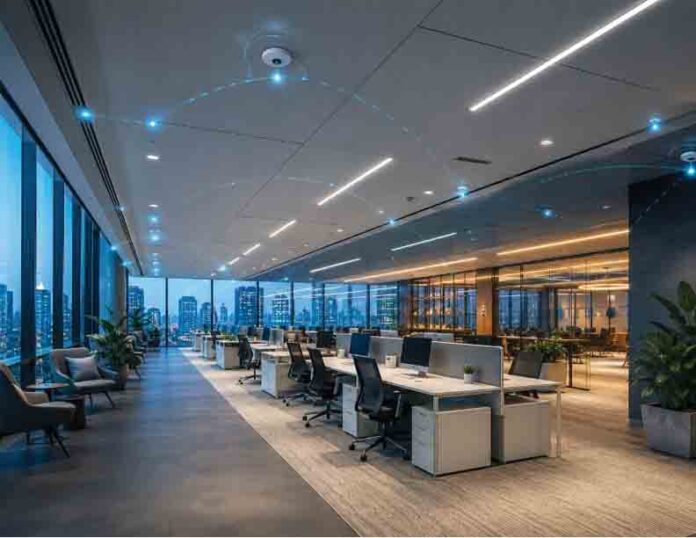
Smart lighting is becoming an important part of connected buildings and urban infrastructure. Modern lighting systems are no longer limited to providing illumination. Sensors, wireless communication, digital controls and software allow lighting installations to respond to occupancy, daylight and usage patterns while giving facility managers greater control over energy consumption.
Efficiency Drives Demand
Energy efficiency remains one of the strongest factors supporting smart lighting adoption. LED technology has already reduced the power requirements of lighting, while intelligent controls can further reduce consumption by ensuring that lights operate only when required.

Occupancy sensors can switch or dim lights in unused areas, while daylight sensors adjust illumination according to available natural light. Scheduling and remote control also help commercial and industrial users manage lighting according to actual operating hours.
The growth of smart buildings is adding further momentum. Lighting is increasingly being integrated with HVAC, security and building-management systems, allowing different services to work together through a connected platform.
Hardware Leads
Hardware remains the largest segment of the market, accounting for around 61%. Connected luminaires, LED lamps, sensors, controllers and gateways form the core of these installations.
Software accounted for approximately 24% of the market. Its importance is growing as lighting networks become larger and more sophisticated. Software platforms allow users to monitor lighting systems, schedule operations, analyse energy consumption and manage installations remotely.
Services account for the remaining share and include installation, integration, consulting and maintenance. As smart lighting becomes part of wider building systems, system integration and commissioning are becoming increasingly important.
Wireless Adoption
Wireless systems accounted for around 54% of the market, compared with approximately 46% for wired systems. Wireless technologies can simplify installation and offer greater flexibility, particularly in residential and commercial applications. Bluetooth Mesh, Zigbee and Wi-Fi are among the technologies being used to connect luminaires, sensors and controls.
Wired systems continue to have an important role in large commercial buildings, industrial facilities and infrastructure projects where reliability and network performance are key requirements. Both approaches are therefore expected to remain relevant, depending on the application.
Indoor Applications
Indoor lighting represents the largest application segment, accounting for around 64% of the market. Offices, residential buildings, healthcare facilities, schools and retail spaces are adopting connected lighting for different reasons. Residential users may prioritise convenience and remote control, while commercial users are more likely to focus on energy savings, occupancy management and centralised operation.
Human-centric lighting is also gaining attention in workplaces, healthcare and educational environments. These systems can adjust intensity and colour temperature to create suitable lighting conditions for different activities and times of day.
Outdoor applications account for roughly 36% of the market. Smart street lighting represents an important opportunity, allowing cities to remotely monitor and control large lighting networks. Connected streetlights can also support sensors and communication equipment for wider smart-city applications.
Regional Outlook
North America held the largest share of the global smart lighting market in 2025, accounting for approximately 38%. Strong adoption of connected homes, smart buildings and energy-management technologies has supported the region’s position.
Europe followed with around 29%, supported by energy-efficiency policies, sustainability targets and investment in modern building infrastructure.
Asia-Pacific accounted for approximately 25% and presents considerable growth potential. Rapid urbanisation, construction activity and smart-city development are creating opportunities for connected lighting across commercial, residential and public infrastructure projects.
Challenges Remain
The market still faces several practical challenges. The initial cost of a connected installation can be higher than a conventional lighting project because sensors, controllers, gateways and software may be required in addition to luminaires.
Interoperability is another concern. Different manufacturers and communication platforms do not always work seamlessly together, making compatibility an important consideration for building owners.
Cybersecurity is also becoming more relevant as lighting systems connect to wider digital networks. Large commercial and public installations will need appropriate security measures as lighting becomes part of a building’s connected infrastructure.
A Wider Role for Lighting
Key companies operating in the market include Signify, Acuity Brands, Honeywell, Itron, Wipro Lighting, Schneider Electric, Yeelight and Sengled. The projected growth highlights how quickly lighting is becoming part of the digital infrastructure of buildings and cities. A connected luminaire can provide data, respond to its surroundings and interact with other systems, giving lighting a role that extends well beyond illumination.
For manufacturers, system integrators and lighting professionals, the opportunity lies in developing solutions that combine efficient illumination with connectivity, automation and useful data. As buildings become increasingly intelligent, lighting is set to remain one of the most visible and widely deployed elements of that transformation.
For more: www.fortunebusinessinsights.com