








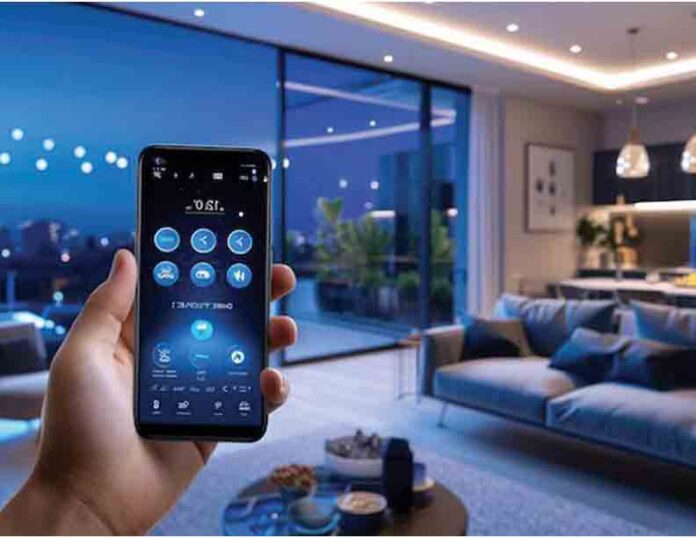
The figures reflect growing demand for lighting systems that combine LED technology with connectivity, sensors, controls and digital platforms. Smart lighting is finding applications across homes, offices, industrial facilities, commercial spaces and urban infrastructure, with energy management and automation remaining important drivers.
Smart Controls
Smart lamps and fixtures accounted for 54.67% of the market in 2025, according to the report. At the same time, control systems are emerging as a significant growth area, with the segment expected to register a 20.19% CAGR through 2031.
Connected controls allow lighting systems to respond to occupancy, daylight and operating conditions. In commercial and industrial environments, these capabilities can support energy management while giving facility operators greater control over lighting performance.

The growing use of sensors, wireless communication and software is also expanding the role of lighting within wider building-management systems. Lighting is increasingly being considered as part of the connected infrastructure rather than as an isolated electrical installation.
Retrofit Demand
Existing buildings represent a major opportunity for smart lighting. Retrofit installations accounted for 62.91% of the market in 2025, according to Mordor Intelligence.
Replacing conventional lighting with LED fixtures provides an opportunity to introduce intelligent controls at the same time. Occupancy sensing, automated dimming and daylight response can help reduce unnecessary energy consumption while improving operational flexibility.
New construction is another important segment. The report expects new-construction installations to grow at a 20.13% CAGR through 2031. The integration of connected lighting during the design stage allows consultants and building owners to plan lighting controls alongside other building systems.
Wireless Shift
Connectivity remains central to smart lighting. Wi-Fi held 49.17% of market revenue in 2025, supported by its established presence across residential and commercial applications.
Bluetooth mesh is also gaining momentum and is expected to record a 20.58% CAGR through 2031. Its suitability for scalable lighting networks makes it relevant for applications requiring multiple connected fixtures.
Interoperability is another area receiving attention. Standards such as Matter are encouraging greater compatibility between connected devices and platforms. For lighting manufacturers, this creates an opportunity to develop products that can operate within wider smart-home and building-automation ecosystems.
Industrial Growth
Residential applications represented 46.73% of smart lighting revenue in 2025, making them the largest end-user segment. Industrial applications, however, are expected to register the fastest growth, with a projected 20.53% CAGR through 2031.
Factories, warehouses and logistics facilities offer strong use cases for connected lighting. Large spaces with changing occupancy patterns can benefit from automated switching and dimming, while networked systems can provide facility managers with greater visibility over lighting operations.
Industrial lighting is also becoming connected with wider digital systems, creating opportunities for advanced monitoring and data-based energy management.
Regional Lead
Asia-Pacific accounted for 37.38% of smart lighting revenue in 2025, retaining its position as the largest regional market. Manufacturing capabilities, urban development and increasing adoption of connected technologies are supporting demand across the region.
The Middle East is expected to be the fastest-growing regional market, with Mordor Intelligence projecting a 20.71% CAGR through 2031. Smart-city initiatives and large-scale construction activity are creating opportunities for connected building systems, intelligent street lighting and energy-management technologies.
For lighting companies, these regional developments present opportunities across residential, commercial, industrial and infrastructure applications.
Security Matters
The increasing connectivity of lighting systems also brings new technical considerations. Cybersecurity vulnerabilities and fragmented interoperability standards remain among the challenges identified by Mordor Intelligence.
This is particularly relevant when lighting networks are connected with wider building-management or industrial systems. Secure communication, reliable software, system compatibility and long-term support are consequently becoming important considerations during product selection and project specification.
Market Ahead
The smart lighting market is developing around a combination of connected hardware, intelligent controls and digital capabilities. The opportunity extends beyond smart lamps and luminaires, with control systems, wireless technologies and integrated building solutions becoming increasingly important parts of the ecosystem.
With the global market projected to reach USD 67.83 billion by 2031, the growth opportunity spans residential lighting, commercial buildings, industrial facilities and smart urban infrastructure. The next phase of market development will depend heavily on how effectively manufacturers and technology providers combine lighting performance with connectivity, automation, energy management and interoperability.