






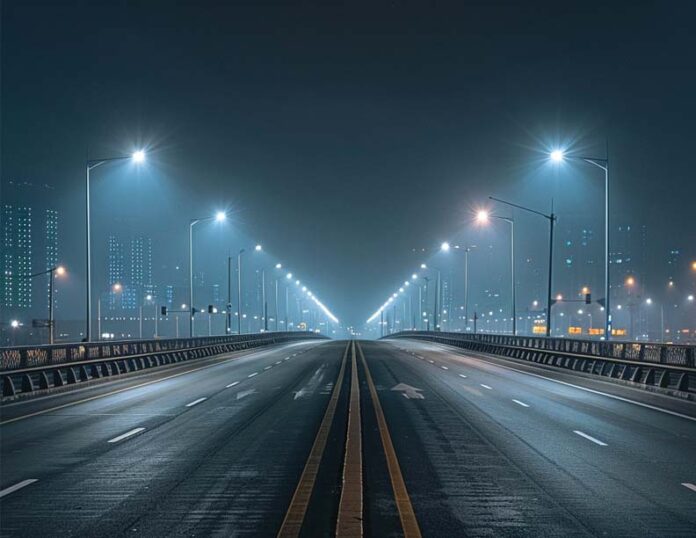
The shift from traditional HPMV to Blended to HPSV & MH lamps happened for street lighting during the last few decades.
However, the past 7 – 8 years we have seen the shift from all these to the LED luminaires and it is still going on. The new street and highway lighting installations are being done with LED luminaires while the replacement of old conventional street light luminaires is also being carried out in parallel.
LED has provided flexibility in terms of installations and streetscaping. The speed at which such installations across all sectors are going on, it becomes important to keep revisiting the technicalities involved in providing a technically correct lighting solution to the users and ensuring the smooth operations of aforementioned activities. It is not only about simply replacing the 150W HPSV with a 72 / 90W LED Luminaire, it is also to ensure that the resultant lighting levels and uniformities are met as governed by the relevant lighting standard (i.e. IS1944 Part II) with its latest amendments or with the National Lighting Code.
A mere replacement of old luminaires with an LED luminaire doesn’t ensure a technically correct solution unless it is backed by a concrete lighting design, proper selection of luminaires, ensuring the right levels of illumination and uniformity and compliance with the relevant standards. LED luminaires provide best advantages available as on date as far as the energy efficiency, longevity and dimming (control) facility. LED also eliminates the problem of selecting cut-off/semi-cutoff luminaires due the directional lighting provided with the use of proper lenses.

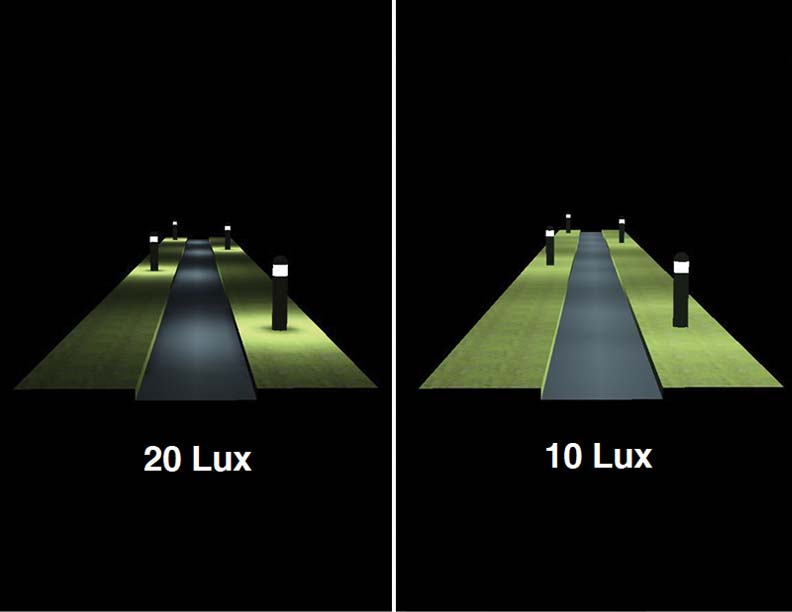
Relevant standards provide a complete guide on the installations, selection of luminaires, the category of roads and the desired illuminations on them along with the uniformities. Now when we discuss about the uniformities involved, it is pertinent to mention here that not only the U0, it is also the U1 which needs to be designed and accounted for. A uniform illumination is more important than a higher illumination with low uniformity. Following pictures of illumination of a pathway are representative enough to provide a clear explanation of the importance of uniformity in street lighting.
Given the comparison above, it is important to keep in mind the uniformity levels to be maintained while doing the installations of street lighting, be it new or be it a retrofit arrangement. Another important parameter, which is not commonly defined or utilized here is the concept of longitudinal uniformity. This is an important consideration in several other countries. The longitudinal uniformity is defined in terms of the ratio of Emin to Emax in a lane. It is essentially required to ensure that there are no abrupt variations in lighting levels within the lane (dark spots or bright patches) which can cause discomfort to the drivers within the lane, on high speed roads. Many countries ensure that there are no bright patches in the lane (specially adjacent to the pole) as a non – uniform illumination may cause bright patches leading to discomfort to drivers which may cause accidents.
Apart from the uniformity, another important parameter to be stressed upon is the avoidance of glare. Now this important aspect becomes critical at the A1 category of roads and the high speed highways and expressways. Modern day developments in lenses has provided precise control over the light beams leading to avoidance of glare and ensuring smooth driving, so far as this aspect is concerned.
Given the technicalities involved above, there is one parameter which is discounted is the aesthetics part of our installations. LED luminaires have developed considerably during the last few years. In case of street lighting, as on date it is possible to provide a 200W street light luminaire in the same size of a housing, which was once suitable for wattages upto 90W only. Nowadays we see installations where the luminaires are barely visible on top of the poles (at the far end of the bracket) which is a complete absence of proportions which used to make it up for the aesthetics part during the day time street furniture aspect of the street lighting installations. However, this aspect can be brought into picture once again in case the utilities define in their specifications, the aesthetics and the dimensions, keeping in mind the proportions which can make it a good street furniture during day time also. This is an important task at hand which can be given to the lighting experts to come up with necessary solutions.
Modern day specifications are defining high CRIs as compared to the earlier systems due to the advantages provided by LEDs. It is not only the CRI, the systems today demand a better thermal management along with high IP and IK factors. It is however important to keep in mind whether the luminaire is required with a glass cover and lenses on the LEDs or a direct PMMA lens cum luminaire cover is the required solution. When the manufacturers encounter a situation of specifications which demand IK10 rating for a 200W street light luminaire with glass cover, it makes the product managers jump out of their seats given the target pricing at which such luminaires are required. This situation can be encountered by providing a direct lens (or as it may be called IP Lens by some) PMMA cover instead of a glass cover resulting into a better solution and higher lumen efficacy. A lot depends upon the specifications which need to be diligently laid down to have a tidy and efficient LED installation. Limiting the ULOR to 1% max results in reduction of light pollution immensely. The efficient and necessary use of above factors (among many others) along with necessary certifications and test reports results in a better and technically correct installation which satisfies the requirements of providing a good street lighting solution by the utilities.
The usage of LED luminaires has resulted in substantial power savings which helps our nation in providing trouble free power to rural areas as well as better power supply in industrial townships. It is estimated that still the total conversion from HPSV to LED is going to take time which is being carried out by various municipalities and ULBs. At the time of writing this article, approximately 1.35 Cr street lights have been converted to LED as per the data available on the website of EESL Dashboard. Given the facts of immense savings in terms of operational costs, the LEDs have also resulted in energy savings of 9031 MUs and 6.2million tCO2 GHG emission reduction as per the data available at the same dashboard.
A street lighting system can be further improved to add to the above advantages through the usage of controls and monitoring. Certain ULBs and authorities insist upon usage of CCMS systems which provide ease of control, monitoring and servicing the system. In case costs become a constraint to go for individual monitoring of the street light systems, the possibility of group control and monitoring can be adopted which is available at various manufacturers. This can further help the utilities add to their savings through dimming at off peak hours and control the system through proper usage of timers. A street lighting system clubbed with a CCMS can result in timely fault detection and save on the maintenance costs for the ULBs. Designers keep such things in mind while preparing their projects and provide a better and cost effective system for their users or clients.
Depending upon the rural/semi – urban/urban requirements, the designers or utilities can also use a solar street light system also which is again a cost effective solution for certain applications like rural areas. There are certain issues associated with the external battery banks but with the availability of integrated solar street lights, one can overcome such issues.
For ensuring a technically correct and advantageous street lighting system, the authorities also need to take care of other parameters like temperature limits, RH, monsoon, dust, theft / vandalism, rural vs urban needs, apart from the other factors discussed in this article. These parameters are not universal and vary from area to area. Accordingly the universal specifications have be modified depending upon the area of application and the territory in which such luminaires are going to be used by the utilities. In order to ensure a technically correct, effective and efficient street lighting system, it is recommended to follow the basic steps enumerated as under:
1.Define Objectives
2.Site Survey
3.Classification of Roads
4.Lighting Calculations using appropriate softwares
5.Product Selection and laying out the basic parameters required
6.Pole Layout Design
7.Integration of Controls (CCMS) as per the requirements
8.Prepare Tender/Specification and add/modify parameters as per the uniqueness of site, if required.
9.Implementation
10.Measurement of illumination levels as per relevant standards and testing of controls (if applicable).
Once the technically correct and efficient street lighting system is provided, lets have a look at how it can help in improving the ESG Performance:
- Environmental: LED Luminaires provide energy efficiency and zero mercury installation, making such systems environment friendly. Reduction in energy consumption (of over 50%) with the use of LED, clubbed with dimming to provide another approximately 50% reduction leads to immense reduction in carbon emissions. Certain estimates as available over internet on the EESL website have already been mentioned in this article. In addition to the energy savings benefits, the usage of precision optics with the help of lenses, leads to considerable reduction in light pollution and ecological disruption.
- Social: A technically correct lighting system provides identification of objects on the roads, due to uniform illumination and helps in reducing accidents, specially in high speed or low visibility zones. Neatly lit spaces enhances mobility and safety for the elderly and such other vulnerable groups/individuals. A good monitoring and control system for the lighting installations helps in developing public safety and trust.
- Governance: System performance monitoring through CCMS (or any other such systems) enables predictive and efficient maintenance of the street lighting network, leading to better lifecycle and ensuring the purpose of such installations are served. It is also a useful tool to ensure energy audits and fault detections. Such monitoring and audits helps the ULBs to ensure better lifecycle and provide better economics.
In order to summarize/conclude, a technically optimized street lighting system – characterized by high efficiency luminaires, uniform illumination and smart controls – play a pivotal role in advancing Environmental, Social and Governance (ESG) foals for the utilities and ULBs.

Gaurav Bhalla is a BE, PGDBM (Mktg.), Chartered Engineer, Fellow of The Institution of Engineers (India) and Fellow of the Indian Institution of Technical Arbitrators. He has been working in the lighting industry for over 25 years. He began his lighting career in lighting design and has since built deep expertise across product development, project execution, operations, and business development. His focus today lies in B2B and B2G sales and marketing, driving large-scale project implementation with technical precision and strategic insight. At present he is a marketing consultant, providing services as CEO to M/s Goldwyn LED.